"Share

Connect with Each Student’s Humanity

Fifteen years ago, Mark was a student in my fourth-grade class. At the beginning of the year, he yelled out, interrupted others and did not do his work. Our school counselor told me Mark had been held back in first grade and lived in poverty.

Mark and I had our roles: He was the defiant student and I, the angry disciplinarian. After an unproductive parent-teacher conference, I decided to change my approach. When he came to class the following Monday, I simply said, “Hi, Mark.” He looked at me in horror and asked, “What did I do wrong now?”

It was then that I realized the only time I talked with Mark was when he was in trouble. What an awful thing to think about! How would I feel about spending 10 months with someone who talked with me only to correct my behavior?
It’s funny to think that we educators forget our students are human. While we know them as learners, we forget that they are people with complete and engaging lives as complex and complicated as our own. The more we understand our student’s reality, the more impact we make on his life and learning. And the more impact that student makes on ours.
I regularly engage my students in non-academic conversation. We discuss their families, what happens when they get home, pets, thoughts about parents, their religion and their culture, heritage and ethnicity. We discuss where they came from, what they want to be when they grow up, their wishes, hopes and dreams.

It’s through these conversations that we connect. Once my students know that I care about them as people, they strive to show me that they care right back, through their hard work, their effort and their loyalty.

You may ask: “How do you make time for this?” By occasionally having lunch with my kids. It’s amazing what barriers break down when you eat together. That’s why Mix It Up at Lunch Day is so powerful.

Connecting with my students means greeting every one every morning with “the H’s”: a genuine hello, and a high-five, hug or handshake. It means having students write in daily journals on whatever topics they want, and me reading and responding to them. There are a myriad of ways this can happen, but it must happen.

In my work as a mentor of beginning teachers, discussions often include challenging students. My first question is always: “What is your relationship like with this student?” Follow-up questions include: “How do you communicate with this student? Does this student know you like him?” The answers often surprise us and lead us to deeper understandings of our practice.

As for Mark, I started talking with him casually, for a minute or two, every day. I learned he loved skateboarding and knights and castles and only ate regularly when he was at school. By the end of the week, he admitted he didn’t know what a sentence was. By the end of the month, he began making academic progress and nearly stopped disrupting the class. At the end of the year, he left me a homemade thank you card, written in complete sentences.

What a victory! And all because I related to him as a person.

Hiller is a mentor to first- and second-year teachers in Oregon and a member of the Teaching Tolerance Advisory Board.

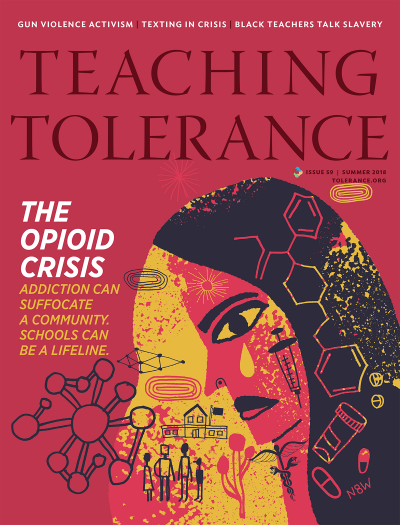
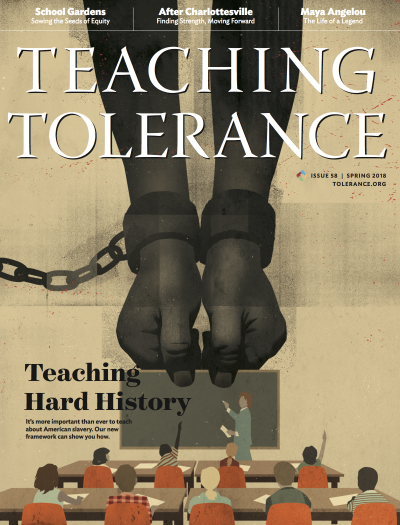
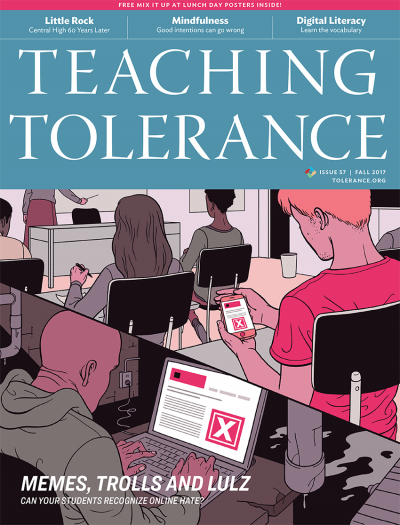
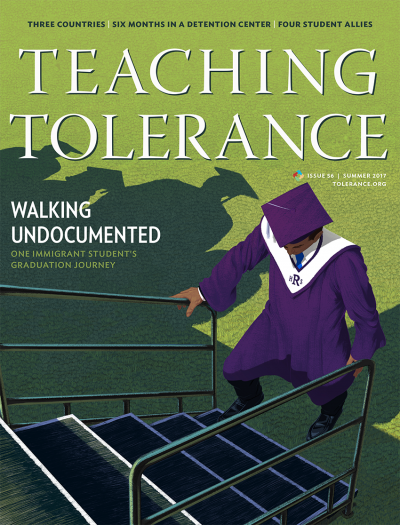
The Debut of Summer 'Teaching Tolerance'

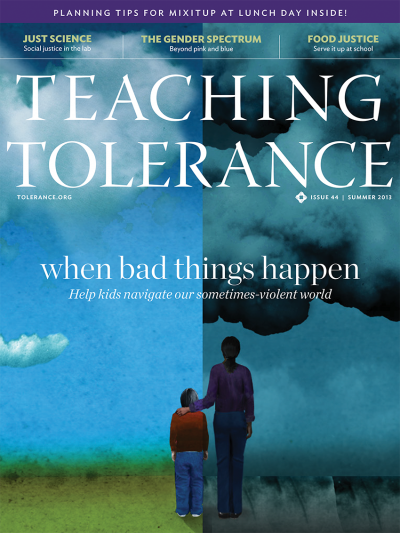
When violence erupts in a community such as Newtown, Conn., or Oak Creek, Wis., schools can play an important role in helping children navigate our sometimes-violent world, according to the inaugural summer issue of Teaching Tolerance magazine, released today by the Southern Poverty Law Center.

The cover story of the Summer 2013 issue—“When Bad Things Happen: Helping Kids Navigate a Sometimes-Violent World”—examines examines how teachers and schools can support their students when they encounter such violence. It looks at steps taken by educators in Newtown and Oak Creek as their communities recovered from deadly shootings. It also offers tools to help students cope with chronic violence in their community or even violence far from their community that receives exhaustive news coverage.

“Community violence can reach into any classroom,” said Teaching Tolerance Director Maureen Costello. “Teachers and schools are in a unique—and crucial—position to help students understand and cope when these tragic events occur.”

The Summer issue is the first digital-only version of the magazine for the iPad. It can be accessed by visiting tolerance.org/subscribe or tolerance.org/magazine/number-44-summer-2013. The digital edition includes video, audio and animation. 

Teaching Tolerance also examines how an Ohio school district with a large number of Amish students created an environment where Amish and non-Amish students cooperate in the classroom, on the playground and forge friendships as they achieve academic goals.

Other articles in the issue examine school challenges for Asian students; how teachers use science lessons to address social justice issues; and how students can learn about community health, equity and sustainable food systems through food justice programs at school.

Teaching Tolerance magazine, published three times a year, is the nation’s leading journal serving educators on diversity issues. It is distributed free of charge to more than 450,000 educators nationwide.

Honoring Religious Diversity

“But that’s not what Jewish people believe!” the round-cheeked student shouted, as the other girl shrank into herself. “That’s wrong!” The other three students looked pained and uncomfortable, and eventually everyone fell silent.

It started as a plan to celebrate Hanukkah. Both students in this disagreement were Jewish. I knew from my upbringing in New York that getting into a competition about “correct” observance was not worthwhile and that I was unprepared to judge it.

When I first became the chaplain at this Episcopal school, there were few precedents for celebrating non-Christian holidays in the chapel. It was very important to me to make sure that students from other religions felt welcome in that space. Luckily, this was in line with the school’s Episcopal identity, which deeply values inclusivity.

Sitting in the back of the chapel with students and discussing how to share Hanukkah (then later, with other groups, Diwali, Kwanzaa, and Eid-al-Fitr), I realized that even with my academic experience, I wasn’t qualified to explain holidays that were not my own. One year, we invited a Hindu parent to come in and speak about Diwali. When we thanked her for sharing her knowledge, she was gracious and remarked (to my surprise) that she’d made good use of Wikipedia. I learned that sometimes when we expect them to be experts, people who practice religion may be hesitant to share their experiences. That means we lose out on hearing their stories.

A lot of the conversation about religious diversity happens during chapel services in my school, but it also can occur in classrooms, in homerooms or in social studies classes. Many teachers (and chaplains) shy away from exploring unfamiliar religious holidays because they are concerned about their own ignorance or about offending families. There’s also the nagging guilt that raises the questions: If we celebrate one holiday, do we have to do them all? How far does inclusion stretch?

Begin with your own community—classroom, school, or neighborhood. Make a space where folks can tell their stories and safely share their religious identities. Offer the opportunity for students of the same tradition to celebrate their stories of religious observance together, even if they don’t overlap perfectly. If you are in a public school setting where there is concern about teaching about religion, having students “show and tell,” with an emphasis on their own family experience rather than religious expertise, can be a way to honor students and their religious traditions. There is room for students to share multiple traditions and the challenges of religious experience.

Harlan-Ferlo is a writer, chaplain and world religions teacher at a PreK-12 independent Episcopal school in Oregon.

Microaggressions Have No Place in School

Among other labels, I am a white, male, heterosexual, nearly middle-aged, solidly middle-class, public middle school social studies teacher. With much of my “middled” identity, readily normalized by American social standards, I am rarely questioned about “what” I am. In this way, I am unfairly privileged. This privilege comes not just from possession, but from what I do not have: namely, perceived atypicalities that people ignorantly challenge through marginalizing discourses or microaggressions.

As a term, microaggression has been around since psychiatrist Chester Pierce’s work in the early 1970s. As an action, microaggression has been present as long as subjugated categories of people have been created. The term was first used in racialized contexts. More recently, its use has expanded to interpret gender and sexuality insults.

Recently, the U.S. Supreme Court heard cases regarding marriage of same-sex couples. Though public opinion is shifting in support of this equality and its concomitant economic benefits, one might look to American teenage vernacular to find contrary evidence. In the halls of my school, in the classroom where I teach, racial, gender and sexuality microaggressions are far too common—and far too commonly ignored.

During a small-group activity in my classroom, I overheard one male student say to another, in what I considered to be an insulting tone, “Does your mom know you’re gay?” My reaction was unfortunately punitive and noneducational: I sent the insulting student out of the room. There was no dialogue, simply a banal monologue on my part about appropriate classroom behavior. Within the rules of the school, this was an acceptable response. And because of this response, I realized that I was guilty of a microaggression against LGBT individuals.

I did not invoke a “teachable moment” and open a discussion with the rest of the students. Another microaggression. Cowardly, I moved on with the class as though the incident had not occurred. I didn’t even speak to the student to whom the comment was directed. I operated under the assumption that he was a default heteronormative preadolescent who needed to ignore comments like the one he had just endured.

Had the comment been about race, class or gender, I would not have avoided the discussion. But this was about sexuality. It’s a contradiction. Were this high school rather than sixth grade, I imagine I would have addressed this issue. LGBT activists, advocates and allies would point to my response and rightly charge that I had not created a safe space for LGBT issues to be acknowledged.

Our students deserve respectful, informed and critical discussions about historically marginalized people. Ignoring these issues with students who are coming of age with respect to their sexualities is a microaggression that demands immediate eradication.

Heise is a sixth-grade social studies teacher living in Utah and  working toward a Ph.d in education, culture and society.

Syndicate content