
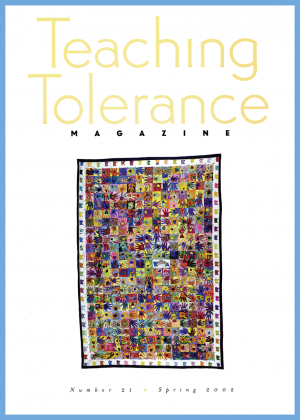
The Southern Poverty Law Center's educational program, Teaching Tolerance, made its debut in the educational world with the first distribution of its semi-annual magazine, Teaching Tolerance, in the spring of 1992.
The inaugural issue of Teaching Tolerance reached about 200,000 educators across the nation and began a new chapter for educators looking to teach more than just reading, writing and arithmetic.
"Ten years ago, 'multicultural' and 'anti-bias' education offered new ways of looking at the classroom community," said Jim Carnes, director of Teaching Tolerance. "But, creating a welcoming environment for every child has always been at the heart of good teaching."
It was that concept that led the Southern Poverty Law Center (SPLC) to begin the Teaching Tolerance program.
"In two decades of civil rights litigation and research, the SPLC became concerned about the dearth of resources available to help teachers teach about civil rights, conflict-resolution and other social justice issues," said Carnes.
"Center supporters signed on whole-heartedly to the idea of expanding the organization's efforts from the courtroom into the classroom by producing and distributing free materials to promote tolerance."
Now, ten years later, the Teaching Tolerance program has become a leader and trailblazer in anti-bias education, and its materials are used in more than 55,000 schools nationwide. The magazine currently boasts a readership of more than 600,000.
"The growth of our audience underscores the importance of addressing tolerance and diversity not as special-interest topics, but as universal, mainstream issues," said Carnes.
The program provides teachers with necessary tools to incorporate lessons of acceptance, tolerance and understanding among an increasingly diverse student population -- something many teachers say is essential in today's classrooms.
"Teaching Tolerance helps us in teaching ways of dialogue that are vital for today's community context," said Sheila Keller, director of community service and human relations for the Pinellas County School System in Florida.
"Our communities today are much more diverse. We interact with each other in ways that we didn't years ago and we need different dialogue than we did years ago. The (Teaching Tolerance) materials help us carry that dialogue into the classroom."
In addition to distributing the semi-annual Teaching Tolerance magazine, the program also has produced a series of educational video-and-text curriculum kits. The program's fifth and newest kit, The Rosa Parks Story, is scheduled for release in the fall of 2002.
In 1997, Teaching Tolerance began a grants program aimed at serving as a financial resource for teachers and education-based community groups wanting to integrate anti-bias curriculum but lacking the funds to do so. To date, the grants program has awarded 615 grants totaling nearly $600,000 to teachers and community groups across the country.
This January, the Girls' Club of Allentown received a $1,000 grant from Teaching Tolerance and was able to implement a multicultural appreciation program for the 900 youths whom it serves each year.
Deborah Fries, executive director of the Girls' Club of Allentown, says the money from Teaching Tolerance helped provide a sorely needed project -- one they may not have been able to begin without the recent grant.
"We serve a diverse group of students and many of them are not very tolerant of each other's different backgrounds," said Fries.
"The grant is helping us teach tolerance and respect to kids from all different backgrounds and it is really eye-opening for many of our kids."
In September of 2001, Teaching Tolerance launched an interactive Web site, widening the reach of its resources to more than just educators.
Carnes says the new site is an important part of moving the program forward and keeping in step with the age of interactivity and technology.
"The Web site has helped us both broaden the reach of our program to include parents and children and deepen our well of resources and services. Features such as the Bias Tests, which measure real-time reactions to stimuli, and Current Events, offering daily tolerance education news links, were inconceivable when our project began."
During its ten-year history, Teaching Tolerance has earned accolades from a variety of professional organizations. The program's materials have earned two Oscar nominations, one Academy Award, and more than ten honors from the Educational Press Association of America (EdPress) including the Golden Lamp Award, the highest honor bestowed by EdPress.
Despite the numerous accolades and accomplishments, Carnes says he and the Teaching Tolerance staff have managed to keep their work in perspective, realizing that the real reward lies in the work itself.
"It's fun to hold an Oscar in your hand, but what stokes the fire is the daily contact with teachers around the country who are making a difference in their communities."
Carnes said he looks forward to many more years of providing schools and educators with free anti-bias resources.
"In many ways, Teaching Tolerance is a kind of fertilizer -- we want to help good ideas grow and spread in our nation's schools. As we plan for next week's Web news and next semester's magazine, we're also looking two and three years down the road to see where new questions, concerns and opportunities might lead us."