

My name is Nhi, a foreign name. My appearance contrasted strikingly with the other girls who wore make-up, blow-dried their hair, and wore stylish clothes. I had a boyish look, favoring plain T-shirts and faded, colored jeans. … Worse, I had a thick foreign accent.
These are the opening lines of 19-year-old Nhi Tong’s personal essay, “Change for the Better,” published in the teen-written magazine YCteen. In it, Tong reflects on moving from Hanoi City, Vietnam, to New York City and her nerve-racking first weeks at Forest Hills High School in Queens. Things changed for the better, she explains, when she stepped out of her comfort zone: making friends, joining a school club, and sharing her real name after going by “Michelle” for over a year.
Stories like Tong’s are at the heart of YCteen—published by the nonprofit organization Youth Communication and distributed throughout New York City high schools. The magazine’s guiding objective is to amplify the voices and experiences of local teenagers, particularly those who are at risk or marginalized. Youth Communication has put this goal into action since its founding in 1980. “The hypothesis was that, when you see that your personal struggles are shared by others, it’s no longer a personal issue. It’s a social issue,” says Youth Communication founder, publisher and executive director Keith Hefner. “It can spark agency and activism rather than depression and despair.”
YCteen’s sister magazine, Represent, is written by and for youth in foster care. The stories featured in both publications also become the foundation for topic-specific story anthologies that address such issues as family, juvenile justice, race and ethnicity, identity, emotional and physical abuse, stigma and others. Youth Communication also offers “Leader Guides,” full curricula including story-based lesson plans and professional development to help any adult who works with young people incorporate the material into their practice.
The project has wide-reaching impact. Last year, YCteen won a Golden Lamp, the most prestigious educational publishing award given by the Association of American Publishers. “What a unique, important and completely compelling publication,” one judge commented. “More than other educational magazines I’ve seen, this one oozes REALNESS.”
The Stories Behind the Stories
Youth Communication recruits writers from the most distressed schools and neighborhoods in New York City. The writers come from diverse backgrounds; their writing skills vary. What unites their work is a desire to write and to make a difference for themselves and their peers.
“We’re not looking for poets or fiction writers or aspiring journalists,” says Holly St. Lifer, editor of YCteen. “We’re really looking for young people who are interested in memoir, who are interested in writing personal stories about their lives.”
St. Lifer and her fellow editors work one-on-one with the writers accepted into Youth Communication’s spring, summer and fall writing programs. “Everyday, she [St. Lifer] would come to my computer and we’d get a chance to dig deeper into what I want to write and how she thinks that I should approach it,” Tong reflects on her summer workshop experience. “[B]ut at the same time, she’s giving me advice in real life and supporting me in a very emotional way.”
For the first time in my life, I'm listening to my own voice.
Writers are encouraged—not once, but over and over again—to reflect on the choices they made to overcome struggles. The editorial staff ask them questions, such as “How will your story help not just yourself but the reader?” and “How will it help them make thoughtful choices?” Each story goes through some 10 rounds of drafts.
“It was really great. … [T]hey would encourage me to freely write and write anything I want and to get things out of my mind,” says YCteen writer Melvin Pichardo. “And then it would be the process of, of course, condensing and taking stuff out, putting more air in. They were just really accepting of my ideas and what I stood for, which is good.”
“We value them,” St. Lifer says. “Now, some kids get this from other places, but many of our writers don’t. They don’t get that validation, they don’t get that respect, they don’t get the feeling that … adults are interested and care about them.”
Inspiration From the Middle
Youth Communication’s editorial model focuses on developing stories that allow readers to see themselves in the narrative and encourages them to take steps toward personal change. “Stories all have a beginning, middle and an end. We shrink the beginning to show just enough of the teens’ struggle to be credible for the reader,” Hefner says. “We help writers expand the middle because the middle is where they describe the strategies they used to manage the struggle. We also shrink the end, because where the writer ends up is not as important as how they got there.”
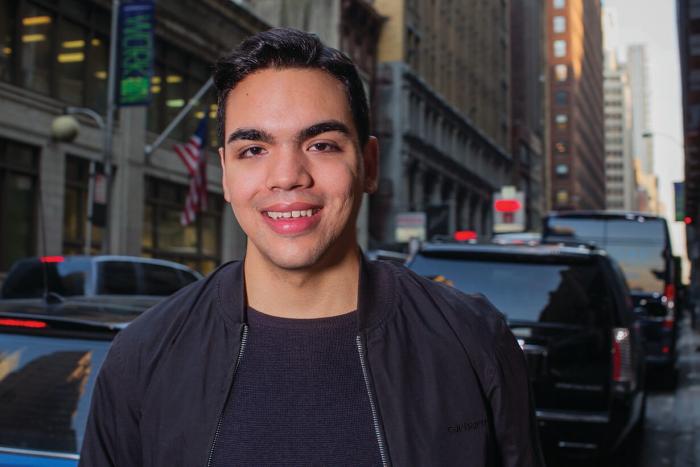
Pichardo’s story “Tough Guise” is a model example. Originally published without his byline, Pichardo writes in the opening paragraph, “My entire life, he [Pichardo’s father] embodied the idea that men are close-minded, emotionless, and are always winners. Only alcohol allowed them to feel sadness or some emotion that wasn’t aggressive.”
As the story unfolds, Pichardo describes how he attended an acting program and played the character Darnell from a scene in August Wilson’s Jitney. In the scene, Darnell—a brash character with a checkered past—admits his vulnerability and love for his girlfriend. Pichardo writes, “Playing Darnell and looking at my father, I came to the conclusion I didn’t want to bottle things up inside me. … Now, instead of being afraid to understand and accept my own happiness, fears and wants—for the first time in my life, I’m listening to my own voice.”
Since graduating from high school and adding his byline to “Tough Guise” last year, Pichardo has shared the story with his former teachers and read it aloud at a YCteen workshop. “It was kind of freeing because I’d never really spoke about this story or shared something that I felt was so personal,” Pichardo says.

Social Emotional and Literacy Tools
The stories published in YCteen and Represent help educators and other youth workers bring authentic teen voices to life in traditional schools, alternative schools and out-of-school settings such as juvenile justice facilities and probation and foster care agencies.
“Out of all the resources I have, [YCteen] is definitely my number one go-to place,” says Eunice Sheppard-Taylor, a substance abuse prevention and intervention specialist at Clara Barton High School for Health Professions in Brooklyn. Sheppard-Taylor educates and counsels students about substance abuse; she also runs Clara Barton’s suspension center. She often shares YCteen stories with students who receive in-school suspensions, anticipating that they’ll hit home. “They see themselves in the stories, which is fabulous, no matter what the story is,” Sheppard-Taylor says.
The stories generate a ripple effect of social emotional learning when used, for example, in group read-alouds and restorative circle discussions. But adult learning is also important to the Youth Communication model. “If I were to sit in a circle and say, ‘Let’s unpack some of our biases on X issue,’ that can be a hard place for a lot of adults to enter,” Education Director Elizabeth Johnson explains. “When we read a story by a young person who’s grappled with obstacles or injustices and [hear] their story about it, then the adults can begin by empathizing.” This empathy-building process, driven by teen voices, is crucial for equity work and professional development.
The hypothesis was that, when you see that your personal struggles are shared by others, it’s no longer a personal issue. It’s a social issue. It can spark agency and activism rather than depression and despair.
Social studies teacher and life-skills class facilitator Gary Kuchmeister says the stories in YCteen have allowed him to take his work at Forest Hills High School to the next level. “[In] the program that I facilitate [called Council for Unity], the premise is the acronym F.U.S.E.—family, unity, self-esteem and empowerment. All that resonates all through all the pages of YCteen,” he says.
Kuchmeister invited Tong, a 2014 Forest Hills graduate, to speak to his Council for Unity students about writing for YCteen. It was a full-circle moment; just a few years prior she was a new student, learning English and stepping out of her comfort zone. “The kids in [Council for Unity] have experienced some trauma, maybe, or have some difficulties believing that they are very great people,” Tong says. “I really appreciate that I get a chance to come back and talk to them.”
And for Kuchmeister’s students, many of whom already see themselves mirrored in YCteen stories, Tong’s visit reiterated that teen voices matter. A lot.
The Story Behind Youth Communication
Keith Hefner founded Youth Communication in 1980 for personal and institutional reasons. “When I was in high school, my own school newspaper … did an exposé on the fact that the football coach was maneuvering to prevent a black player from becoming a quarterback on the football team, which was very common in those days,” says Hefner. But the principal took the paper and locked it in a school safe, promoting outrage among students. The paper ended up being distributed, and the black player became quarterback. “[I]t was very visceral for me as a kid to go, ‘Wow, look at that. Young people knew stuff that adults didn't know. They exposed it and change happened.’”
In 1974, a Robert F. Kennedy Memorial study documented censorship in high school media and the exclusion of “minority” voices. “They proposed the creation of city-wide independent teen newspapers, which wouldn't be under the jurisdiction of any one principal,” Hefner says. “If they were done in urban areas, they would be likely to have a more diverse staff.” This recommendation lead to a city-wide paper out of Chicago, which Hefner subscribed to and was so inspired by that he created a sister paper—New Youth Connections (renamed YCteen in 2011)—out of New York City.

Bring YCteen stories to your students with literacy-based tasks and strategies from our anti-bias curriculum.
